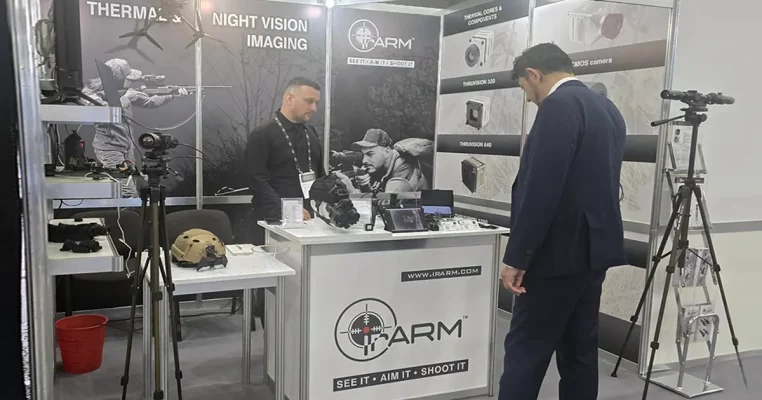
irARM™ at HEMUS 2026: Thermal Imaging Comes Home to Plovdiv
Field Report // HEMUS 2026 // Plovdiv, Bulgaria This week the irARM™ team is on the exhibition floor at HEMUS



In the realm of hunting, few pursuits are as thrilling and challenging as tracking and taking down the formidable wild hog. These cunning creatures, known for their resilience and elusive nature, demand a level of skill and preparation that separates the seasoned hunter from the novice. However, with the advent of cutting-edge thermal imaging technology, hunters now have a powerful ally in their quest to conquer the nocturnal world of hog hunting.
Thermal scopes, once a luxury reserved for military and law enforcement personnel, have become increasingly accessible to outdoor enthusiasts and hunters alike. These remarkable devices harness the power of infrared radiation, allowing users to detect heat signatures and visualize their surroundings with unparalleled clarity, even in complete darkness.
As the sun dips below the horizon and the veil of night envelops the hunting grounds, thermal scopes come into their own, providing hunters with a distinct advantage over their prey. By detecting the faint heat signatures emitted by living organisms, these scopes unlock a world of possibilities, enabling hunters to track and engage their quarry with precision and stealth.
 In this article, we will delve into the intricacies of thermal scopes and their application in the exhilarating pursuit of hog hunting. We will explore the features that set these devices apart, the benefits they offer, and the considerations hunters should keep in mind when selecting the perfect thermal scope for their needs.
In the ever-evolving landscape of thermal imaging technology, one name stands out as a beacon of innovation and quality: irARM™. This renowned manufacturer has dedicated itself to pushing the boundaries of night vision capabilities, crafting thermal scopes that seamlessly blend cutting-edge technology with user-friendly design.
The irARM™ line of thermal scopes is engineered to provide hunters with an unparalleled advantage in the field. Powered by advanced algorithms and exceptional imaging solutions, these scopes ensure that no target goes undetected, even in the most challenging hunting environments.
One of the hallmarks of irARM™ thermal scopes is their ability to deliver accurate and precise thermal imaging under any condition. Whether you’re navigating dense foliage, battling adverse weather, or operating in complete darkness, these scopes will provide you with a clear and detailed view of your surroundings, allowing you to identify and track your prey with ease.
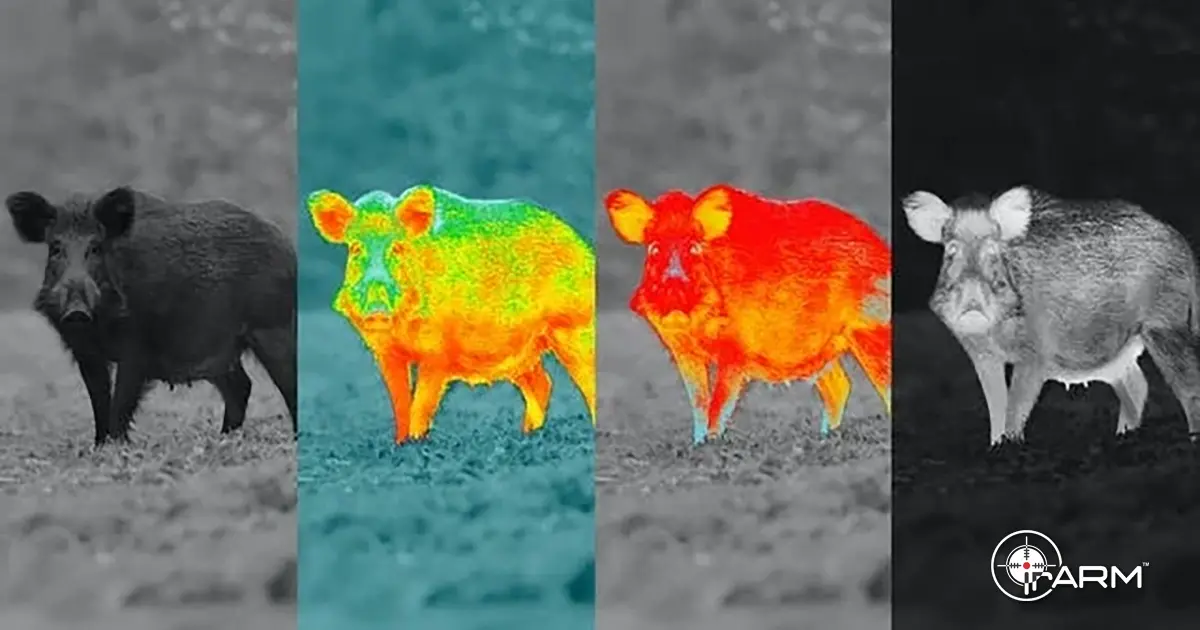
Both technologies are sold for the same job and they do not solve the same problem. Night vision amplifies the light that is already there, so it needs moonlight, starlight or an infrared illuminator you carry. What you get back looks like a scene, with texture and shape, which makes identifying an animal straightforward. In heavy cover or under cloud it falls away, and an IR illuminator puts out a beam that other equipment can see.
Thermal detects heat and needs no light at all. A hog in complete darkness is a bright shape against a cool field, and it stays a bright shape in fog, in light rain and behind grass that would hide it completely from night vision. What thermal does not give you is detail. You see a heat signature, not markings, so telling a boar from a sow, or a hog from a calf, comes down to size, shape and movement.
For hogs, thermal wins on detection and night vision wins on identification, and detection is usually the harder half of the problem, because a group of hogs in standing crop stays invisible until it is already close. That is why most people who hunt hogs regularly end up on thermal scopes, and why some carry a night vision device as a second optic for identification at short range.
 Hog hunting presents a unique set of challenges that demand specialized equipment and techniques. These hardy and elusive creatures are predominantly nocturnal, making them exceptionally difficult to spot and track during the day. Furthermore, their keen senses and ability to adapt to various environments make them formidable opponents for even the most experienced hunters.
Enter thermal imaging technology, a game-changer in the world of hog hunting. By harnessing the power of infrared radiation, thermal scopes enable hunters to detect the faint heat signatures emitted by the hogs, even in complete darkness or dense vegetation.
For instance, the irARM Hawk 640-75 Thermal Scope offers a high-end thermal solution with its 640 × 480 12µm detector type and a 75 mm lens system. This scope provides a narrow field of view but excels in long-range detection and identification, making it perfect for spotting distant hogs. Its built-in digital enhancement image processing ensures clarity, even in challenging environments.

When it comes to thermal scopes for hog hunting, irARM™ stands out as a brand that truly understands the needs and demands of modern hunters. Their line of thermal scopes is designed to deliver unparalleled performance, combining cutting-edge technology with user-friendly features that enhance your hunting experience.

For example, the irARM ThruVision 1280 Thermal Core showcases a 1280 x 1024 array format with a 12µm pixel pitch, delivering high-quality, detailed images. This thermal core features an adjustable image orientation and continuous digital zoom, allowing hunters to tailor their view to their specific needs. The integrated eMMC storage and USB streaming capabilities make it a versatile tool for capturing and reviewing your hunts.
Thermal sensors are described by their pixel count. A 320 sensor is 320 pixels wide, a 640 sensor is 640 pixels wide, which is four times the total pixels. The number matters because of one rule: you need a certain number of pixels across a target before you can tell what it is. Detection, meaning there is something warm out there, takes very few pixels. Recognition, meaning that is an animal and not a fence post, takes more. Identification, meaning that is the hog you want, takes more again.
At the same distance with the same lens, a 640 sensor puts twice as many pixels across the animal as a 320. In the field that buys you one of two things and you choose which: the same distance with more certainty, or the same certainty further out.
A 320 sensor is not a compromise for close work. If most of your shots fall inside 100 metres over a feeder or a field edge, a good 320 gives a clean, usable picture for less money. The 640 earns its price when distances open up, when you hunt large fields, or when you want the option of shooting further than you do today. Both sensor sizes run right through the Hawk scope line.
The lens does two things at once and they pull against each other. A longer lens magnifies, putting more pixels on a distant animal, and it gathers more thermal energy, which helps the image hold together at distance. It also narrows the field of view, so you see a smaller slice of the ground in front of you. A shorter lens gives a wide field of view: you find animals faster, you follow a moving group without losing them, and close shots do not feel claustrophobic. What you give up is reach.
| How you hunt | Sensible starting point |
|---|---|
| Thick cover, feeders, close field edges, most shots under 100 m | Short lens, 25 or 35 mm |
| Mixed ground with some open fields, shots out to roughly 150 to 200 m | 50 mm |
| Large open fields and ridge lines, long shots as the norm | 75 mm |
If you are unsure, the middle of the range is the safer mistake. A scope with too little field of view is frustrating every single time you pick it up. A scope with slightly less reach than you wanted only costs you on the rare long shot. If reach is the deciding factor on your ground, it is worth reading how far you can actually shoot with a thermal scope before you choose.
NETD stands for noise equivalent temperature difference. It is measured in millikelvin and it describes the smallest temperature difference the sensor can distinguish. Lower is better, and it matters most in exactly the conditions hog hunting happens in. On a cold dry night a hog is dramatically warmer than the field and almost any sensor shows it clearly. In humid air, in light rain, in fog, or after a warm day when the ground has not cooled, the gap between animal and background shrinks. That is when a low NETD sensor still gives you a usable image and a high NETD one gives you grey soup. If you hunt in a humid climate or through the shoulder seasons, treat NETD as a buying criterion rather than a line on a specification sheet.
With irARM™’s innovative thermal imaging technology, hog hunting is transformed into a precise and controlled adventure. Their advanced thermal scopes enhance your ability to detect and track prey, offering unparalleled clarity and detail.
Imagine the thrill of scanning the dense undergrowth, your irARM™ thermal scope revealing the faint heat signatures of a herd of hogs, their movements visible even in the darkest of nights. With the advanced imaging algorithms and high-resolution sensors, you can identify individual animals, track their movements, and plan your approach with surgical precision.
 As you close in on your quarry, the user-friendly interface and intuitive controls of your irARM™ thermal scope allow you to make quick adjustments, ensuring that your shot is true and your aim is unwavering. The durable construction and weather-resistant design ensure that your scope remains a reliable companion, regardless of the environmental challenges you may face.
But the irARM™ advantage doesn’t stop there. With extended battery life and versatile mounting options, you can embark on extended hunting expeditions without worrying about power drain or compatibility issues. And when the hunt is over, you can relive the excitement through the captured footage or images, made possible by the built-in recording capabilities of all of the irARM™ thermal scopes.In the ever-evolving world of hog hunting, where success is measured by skill, preparation, and the ability to adapt, irARM™ thermal scopes exemplify innovation and performance. By combining irARM™ ThruVision technology with a deep understanding of the hunter’s needs, irARM™ has created a line of thermal scopes that truly elevate the hunting experience, transforming every outing into an unforgettable adventure.
Field Report // HEMUS 2026 // Plovdiv, Bulgaria This week the irARM™ team is on the exhibition floor at HEMUS

Over the last decade, thermal imaging has become widespread. Today, tactical dominance is no longer about who detects it first,

Introduction Pedestrian safety is an ever-growing concern for vehicle manufacturers, especially as the number of pedestrian-related accidents continues to rise.