A PhD in physics and CEO of Erglon, Ltd, specializing in thermal imaging, multi-spectrum optics, and AI-enhanced vision systems, leading the development of advanced sensor integration and real-time perception platforms for next-generation applications.
March 11, 2026
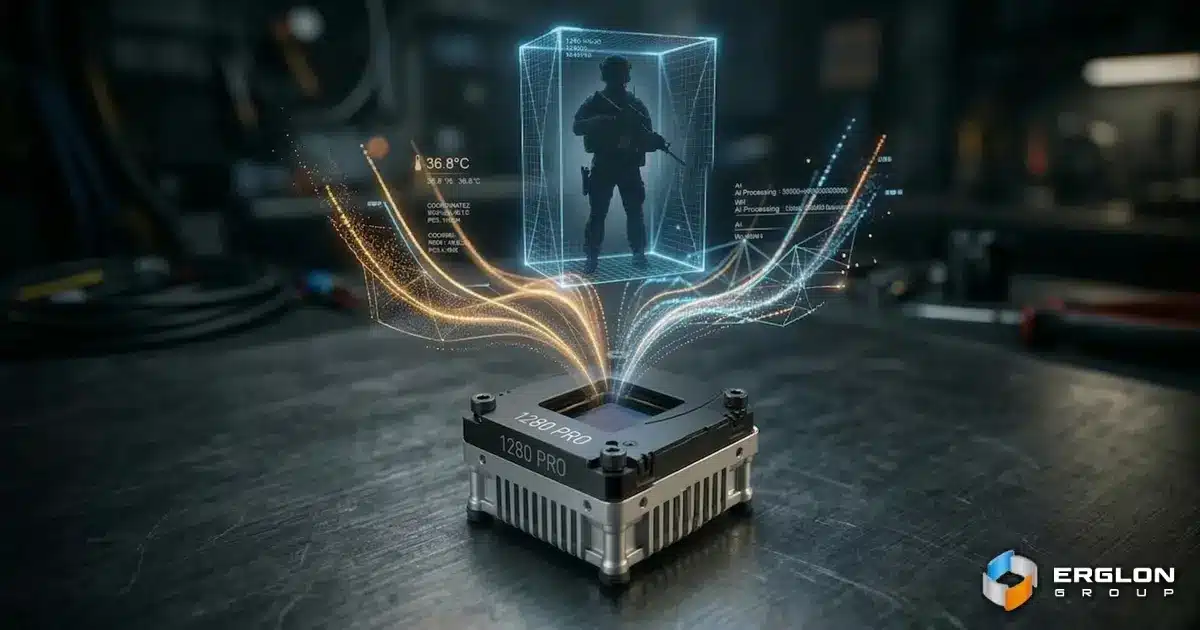
Over the last decade, thermal imaging has become widespread. Today, tactical dominance is no longer about who detects it first, but who understands it first, under pressure, in degraded environments. This paper presents the evolution of compact thermal cores, from the classic 320 and 640 cores to the new-generation 1024 and 1280 PRO imaging platforms, demonstrating how sensor miniaturization and advanced multi-spectrum processing architectures enable superior imaging within footprints as small as 21 × 21 mm. By integrating AI-assisted target recognition, modern thermal systems now deliver real-time object classification and situational alerts directly at the edge, reducing operator workload and latency in mission-critical scenarios. We can further explore the fusion of IIC, LWIR, SWIR, and visible bands to enhance environmental adaptability, improve range discrimination, and increase operational safety under adverse visibility conditions. In addition, we can examine advances in low-power thermal vision tailored for dismounted units, UAVs, and autonomous ground systems, highlighting new approaches to energy-efficient design and thermal-noise optimization. Together, these developments define the next generation of multi-sensor tactical imaging systems, portable, intelligent, and seamlessly networked, empowering defense and law-enforcement professionals to “see beyond” traditional visual limits.
For a complete overview of the concepts discussed in this article, you can watch the full video presentation below:
Before we discuss technology, we need to discuss operational reality. Because technology only matters if it responds to operational reality. The reality is that the tactical environment has fundamentally changed.
First — visibility conditions. Darkness is no longer the exception. It is the operating baseline. Add smoke. Add fog. Add dust. Add dense urban structures. Modern environments are layered, obscured, and visually complex. Operators rarely work under clean, ideal conditions. They operate in degraded visual environments by default.
Second — engagement speed. The timeline between detection and action has compressed. Whether it’s urban operations, border security, or UAV-based ISR, threats emerge quickly and disappear quickly. The window to detect, identify, decide, and respond is shrinking. Milliseconds accumulate. Hesitation increases exposure. Slow interpretation is no longer acceptable.
Third — cognitive load. Operators today manage Multiple sensor feeds, Multiple communication channels, and Multiple threat vectors, and are expected to reconcile this information in real time. Switching between thermal and visible feeds. Interpreting ambiguous signatures. Managing radio traffic. Cognitive overload reduces accuracy and increases fatigue. And fatigue increases error.
Fourth — multi-domain threats. Threats are no longer confined to a single environment. Air — drones and aerial ISR. Land — vehicles and ground personnel. Urban — dense civilian structures and infrastructure. Modern tactical systems must operate seamlessly across domains. That demands integrated perception — not isolated sensing.
And finally, compressed decision timelines. Detection used to be the goal. Now detection is only step one. Identification, classification, and prioritization — all must happen almost simultaneously. If the system only shows imagery, the burden shifts to the operator. If the system assists with interpretation, decision-making time shortens. That difference determines operational advantage.
The tactical environment has changed faster than sensor architectures have evolved. Legacy systems were built for detection. Modern operations demand intelligence. That is why compact cores, embedded fusion, and AI-assisted perception are not luxury upgrades. They are necessary adaptations. If the environment changes, our sensing systems must evolve with it. And that evolution is what we’ll explore next.
Before we talk about innovation, we need to acknowledge where we started. Thermal imaging revolutionized night operations decades ago. It gave forces the ability to see what was previously invisible. But the original paradigm was built for a different era. And that paradigm has limits.
First — size and power. Legacy thermal systems were large, heavy, and energy-intensive. High-power FPGAs. Discrete processing boards. Significant thermal management requirements. They worked — but they were not optimized for today’s mobility-driven operations. When you’re mounting systems on drones, helmets, or lightweight weapon platforms, mass and power become critical constraints.
Second — isolation. Traditional thermal devices were stand-alone tools. You had a thermal sight. You had a visible camera. You had separate communication systems. Each operated independently. That meant operators had to mentally integrate information across devices. Integration occurred in the human brain, not in the system.
Third, interpretation was entirely human-driven. The sensor showed heat signatures. The operator had to determine whether it was a threat. Is that a vehicle? Is that a civilian? Is that a reflection? The system detected. The human interpreted. That worked — but it placed an enormous cognitive burden on the operator.
Fourth — delay. Because systems were heavy, processing-intensive, and not integrated, latency layers emerged. Even small delays accumulate. Switching views. Interpreting ambiguous shapes. Reconciling multiple feeds. Those seconds matter in modern engagements.
Fifth — architecture. Early systems relied heavily on FPGA-based pipelines. FPGAs are powerful, but they are not always efficient for adaptive, AI-driven workloads. They consume power. They increase system size. They limit flexibility. Today’s requirements demand heterogeneous processing — optimized SoCs, AI accelerators, and edge intelligence.
And finally — perhaps the most important limitation: Detection without context. Legacy thermal systems answered one question very well: Is something warm? But modern operations require more: What is it? What is it doing? Is it relevant? Is it a threat? Detection is no longer enough. Context is everything.
So the old thermal paradigm was groundbreaking for its time. But it was built around detection. Today’s environment demands interpretation, integration, and intelligence. That’s the shift we are making. We are moving from thermal as a viewing device…to thermal as an intelligent perception system.
This represents one of the most important technical shifts in modern thermal imaging: Resolution without footprint explosion. Historically, increasing resolution meant increasing size, power, and system complexity. That tradeoff no longer applies.
From 320 → 640 → 1280 and Beyond. We’ve moved from 320 VGA cores… To 640… To 1280… And now pushing toward 1440-class performance — all within compact core architectures. And we did not double the enclosure size. We did not double the power draw. We did not double the weight. That’s a structural change in sensor engineering.
Let’s talk physics for a moment. Legacy thermal cores commonly used a 17-micron pixel pitch. Then we moved to 12 microns. We’re now seeing 8.5-micron technologies emerge. Smaller pixel pitch means: Higher pixel density per area, Higher spatial resolution, Improved target discrimination. All within similar detector footprint dimensions. It’s not just about more pixels — it’s about more intelligence per square millimeter.
Higher resolution directly translates into a wider identification range. Detection might occur at a long distance. But identification requires pixel density on the target. The more pixels across a human silhouette or vehicle profile, the greater the classification confidence. Higher resolution compresses the detection-to-identification gap.
Digital zoom used to be the weak point. Zoom in on a 320 system, and detail collapses. With 1280-class sensors, digital zoom becomes usable. You maintain the image’s structural integrity. That reduces reliance on optical zoom systems, which are heavier and mechanically complex.
Same footprint—higher intelligence. That means: No penalty in weight for dismounted units. No penalty in payload for UAVs. No penalty in enclosure redesign for OEM platforms. Instead, you get more usable information from the same physical volume.
This is not an incremental improvement. This is density scaling. We are packing more perception capability into smaller, more efficient modules. And when you combine high resolution with: Embedded fusion, Edge AI, Secure connectivity. You’re no longer just improving image clarity. You’re increasing operational effectiveness. Resolution scaling is not about sharper pictures. It’s about extending the identification range, preserving detail under zoom, and delivering more intelligence without increasing the system burden.
What matters next is the architectural shift that made everything else possible. We didn’t just improve sensors. We restructured the core.
Early thermal systems were monolithic. The sensor was separate. The image processing board was separate. The FPGA pipeline was separate. The communication stack was separate. Integration was custom and rigid. Every new platform required a redesign. Scaling performance meant adding hardware layers — which increased size, weight, and power.”
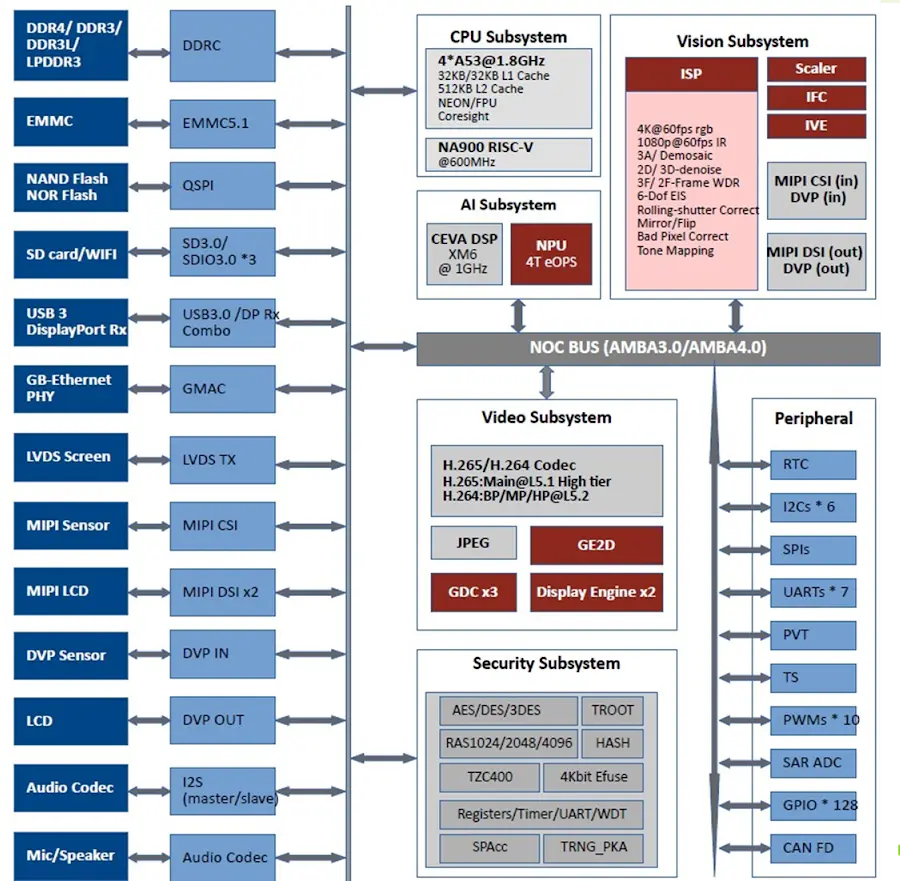
Today, the architecture looks very different. We now integrate: The sensor, the ISP, and the processing subsystem. The AI acceleration and security modules. All within a compact, unified core. Instead of distributed subsystems, we have cohesive compute platforms. That reduces latency, simplifies integration, and increases reliability.
Standardization is a major breakthrough. MIPI CSI, DVP, LVDS, USB, Ethernet. Standardized interfaces allow the thermal core to plug into: Weapon sights, UAV payloads, Vehicle systems. Fixed security nodes without re-engineering the entire processing chain. The core becomes a module — not a custom build.
This leads directly to platform-agnostic deployment. The same compact core can operate on a drone, a rifle, a ground robot, and in a surveillance tower. Because the compute and vision subsystems are modular and self-contained. The platform becomes secondary. The core carries the intelligence.
Rapid integration is a strategic advantage. When OEMs or system integrators can deploy a compact thermal core without redesigning their architecture, development cycles compress. Time to deployment shortens. Upgrade paths become smoother. And AI or firmware enhancements can be rolled out across multiple product families simultaneously.
Look at the diagram. You see not just a sensor — but a full subsystem: CPU cluster, AI accelerators, ISP chain, Video codecs, Security modules. This is not a camera module. This is a perception computer.
The evolution from monolithic to modular enables higher-resolution scaling, embedded multi-spectrum fusion, Edge AI, and Secure connectivity without increasing system size. The compact thermal core becomes the foundation for intelligent imaging platforms. Thermal cores are no longer just imaging components. They are modular intelligence engines — deployable anywhere, adaptable everywhere.
When we talk about performance, most people immediately think about resolution, AI, fusion, and detection range. But in real operations, power is often the limiting factor. Power is not just a specification on a datasheet. Power is a tactical constraint.
I intentionally use this phrase: Power is a weapon. Because energy management determines endurance. And endurance determines operational advantage.
For dismounted units, battery weight is a physical burden. Every additional watt means: More batteries carried, More weight, More fatigue. If a thermal device drains power inefficiently, it directly reduces mobility and operational duration. Energy-efficient cores extend mission time without increasing load. That is not convenience — that is survivability.
Now consider UAV platforms. Flight time is everything. Every watt consumed by the payload reduces: Loiter time, ISR persistence, and operational coverage. When thermal cores consume less power and process intelligently at the edge, the aircraft stays in the air longer. Longer presence means more intelligence gathered and greater mission effectiveness.
Persistent surveillance systems — border towers, fixed nodes, perimeter systems — operate continuously. They may rely on: Solar panels, Limited battery banks, and remote power sources. Inefficient systems shorten operational cycles and increase maintenance frequency. Energy-efficient imaging cores allow continuous operation with fewer interventions.
The solution is not simply reducing performance. It’s intelligent power management. Adaptive frame-rate control. Dynamic power scaling. Processing on demand. When motion is minimal, the frame rate can be reduced. When detection events occur, performance scales up. This kind of smart control preserves energy without sacrificing operational readiness.
The future of tactical imaging is not just higher resolution and AI acceleration. It is performance per watt. The most capable system is useless if it cannot sustain operations. Energy efficiency is now a mission requirement.
In modern tactical systems, power does not just enable performance. Power defines endurance. And endurance defines advantage.
Everything we’ve discussed so far — compact cores, higher resolution, fusion, power efficiency — leads to this moment: Pixels are not intelligent, Pixels are raw data, and raw data does not win engagements, Intelligence does.
We are now in an era where imaging systems cannot simply display scenes. They must interpret them. That interpretation must happen at the edge — inside the device itself.
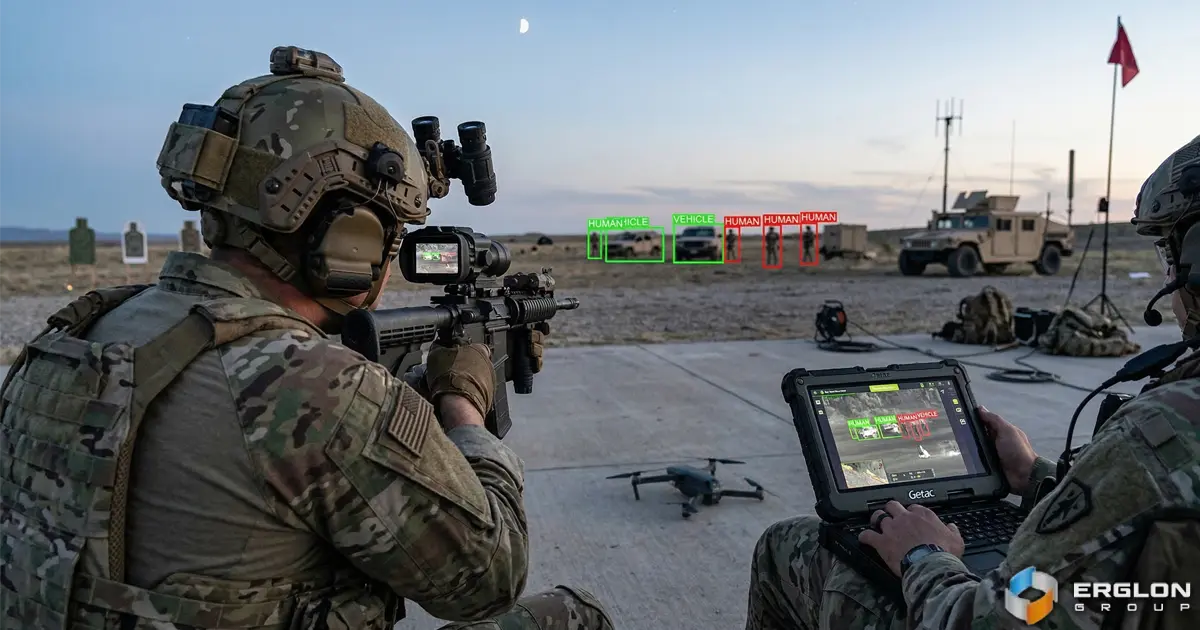
First — operator workload. Operators today monitor multiple feeds. Thermal imagery alone requires interpretation: Is that a threat? Is it moving? Is it relevant? Edge AI reduces cognitive burden by performing: Object detection, Human classification, Vehicle recognition, and Anomaly detection. Instead of scanning every pixel manually, the operator receives prioritized information.
Second — speed. Human reaction time is finite. Edge AI runs continuously. It can detect patterns and signatures faster than manual interpretation. That reduces the time between Detection, Classification, and Decision. Milliseconds saved at the recognition stage translate into seconds saved at the engagement stage.
Third — resilience. Cloud-based AI is unreliable in tactical environments. Bandwidth may be limited. Signals may be jammed. Networks may be compromised. If intelligence depends on connectivity, intelligence disappears when connectivity disappears. Edge AI ensures that recognition and prioritization continue even in denied or degraded environments.
Cloud dependency introduces latency and vulnerability. Streaming high-resolution thermal or multi-spectrum feeds to remote servers consumes bandwidth and increases delay. Edge processing eliminates that round-trip. The data stays local. The decision stays local. That is operational autonomy.
This is why we say: From pixels to intelligence. The imaging core is no longer just a sensor. It becomes a perception engine. It detects. It classifies. It prioritizes. And it does so in real time. When you combine edge AI with Multi-spectrum fusion, higher resolution, and Embedded processing, you create systems that not only see targets but also understand them in context. The result is: reduced operator fatigue, Faster response times, higher-confidence decisions, and Improved survivability. This is not automation replacing operators. This is an augmentation enhancing performance.
In modern tactical environments, intelligence cannot wait for the cloud. It must live at the edge. And that is why edge AI is no longer optional — it is foundational.
There’s a lot of marketing noise around AI. But what does AI actually do in thermal imaging — in the field — under real operational pressure? It does four things that materially change outcomes.
First — classification. Thermal alone shows heat signatures. A blob is a blob. AI transforms the blob into one of the following: Person, Vehicle, Animal, or Unknown object. That classification reduces interpretation time dramatically. The operator no longer asks, “What am I looking at?” The system tells them. And it does so consistently — regardless of fatigue, stress, or environmental ambiguity.
Second — prioritization. Not all detections are equal. AI models continuously evaluate: Direction of movement, Speed, Trajectory changes, Behavioral anomalies. A stationary warm vehicle is low priority. A moving vehicle approaching a restricted zone is not. AI ranks threats in real time. This is where thermal imaging becomes tactical filtering.
Third — context awareness. This is where intelligence goes beyond detection. A human walking in a city street at 2 PM? Normal. A human running across a restricted perimeter at 2 AM? Different scenario. Edge AI can incorporate Geofencing, Time-of-day rules, Behavioral patterns, and sensor-fusion context. Instead of constant alarms, operators receive meaningful alerts.
Fourth — false positive reduction. Thermal imaging is powerful — but it reacts to heat. Hot rooftops, Exhaust vents, Industrial equipment, Animals. AI learns pattern geometry and movement signatures. This reduces nuisance alerts dramatically. False positives are not just annoying — they erode trust in the system. And once operators stop trusting alerts, the system fails strategically.
What does this mean operationally? When you combine: Classification, Prioritization, Context awareness, and False positive suppression. You reduce cognitive overload. And cognitive overload is one of the most underestimated tactical risks today. In real deployments, this translates to Faster recognition, Cleaner decision chains, Lower fatigue, and higher confidence. AI does not replace the operator. It augments perception.
And let me emphasize something important: AI in thermal imaging is not about flashy overlays. It is about decision acceleration. The value is not the bounding box. The value is the reduced time between detection and understanding. We are transitioning from Sensor-centric systems to Decision-centric systems. Thermal cameras capture heat. Now they extract meaning. In the field, AI in thermal imaging is not a feature. It is a force multiplier. And when implemented correctly — at the edge, securely, and in real time — it becomes one operational advantage.
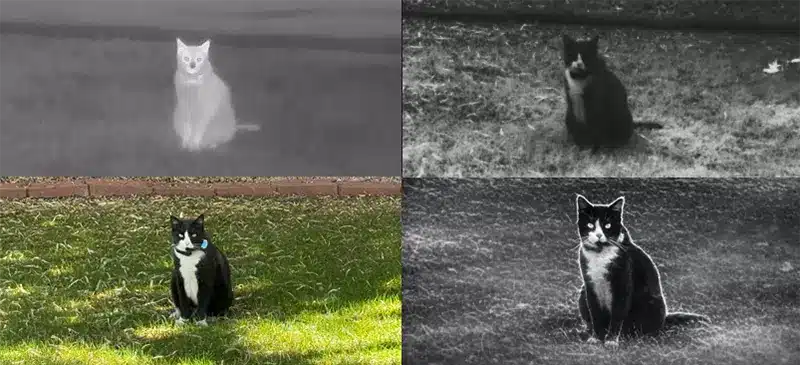
In this image, you see three representations of the same environment. A thermal view, a visible-spectrum view, and a processed high-contrast version. Each tells a different story. None of them tells the full story. Let me explain why.
One of the primary limitations is thermal crossover. At dawn and dusk, when the ambient temperature matches the object’s temperature, contrast collapses. Buildings, roads, vehicles — everything begins to blend. In those moments, thermal detection reliability drops dramatically. The sensor hasn’t failed — physics has shifted. If your system relies solely on LWIR contrast, you now operate in a degraded mode.
Second — texture. Thermal shows heat gradients, not material detail. You can detect a person. But can you distinguish posture? Equipment? Behavioral cues? Edges are present, but the texture resolution is limited relative to visible or shortwave infrared wavelengths. For identification, context matters. And thermal alone does not provide sufficient context.
Third — ambiguity. Heat does not equal threat. A warm exhaust pipe. A heated rooftop. Reflected thermal energy. Without spectral cross-confirmation, operators must interpret ambiguous shapes. Interpretation under stress increases cognitive load, which in turn increases error.
So operationally, what does this mean? It means that relying on a single spectrum creates blind spots — not because the technology is weak, but because reality is complex. No single band solves all environmental variables. Thermal excels at detection. But identification and confidence require additional data layers.
This is why the industry is moving toward multi-spectrum fusion. LWIR gives detection. SWIR provides penetration and material differentiation. Visible delivers recognition and context. When you combine them, ambiguity drops. Decision confidence increases. Reaction time decreases. And that — ultimately — is the mission. Thermal imaging revolutionized night operations. Multi-spectrum intelligence will define the next decade of tactical dominance.
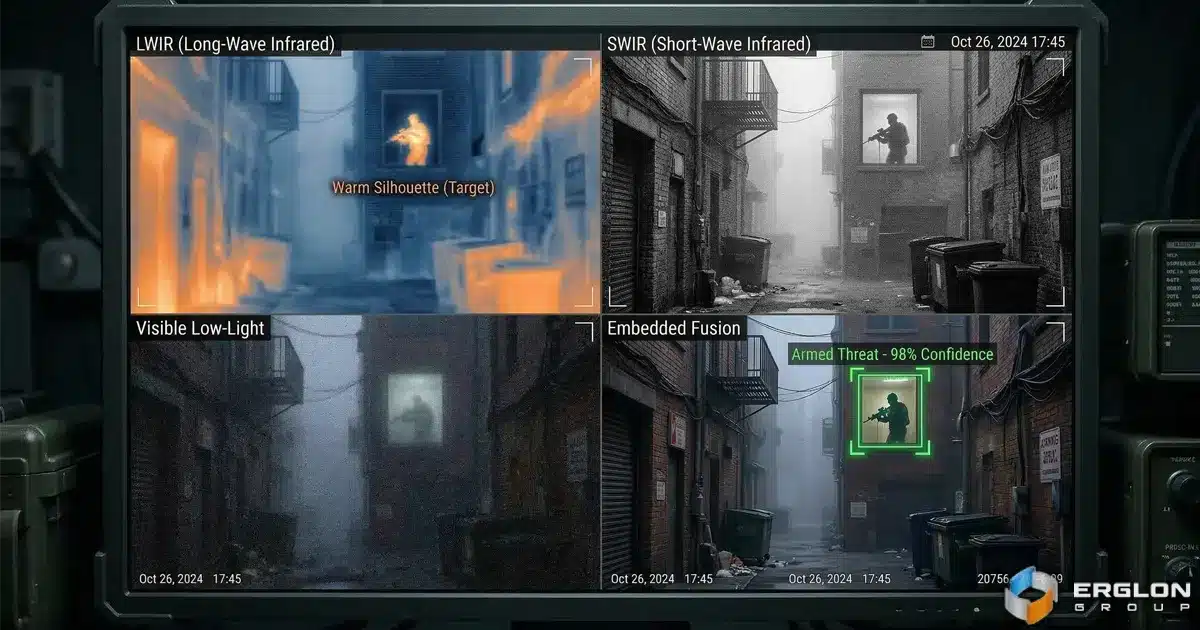
In the image, you see the same scene across three spectral domains — and then the fused result. Each band solves a different tactical problem.
LWIR is the detection engine. It sees heat signatures independent of visible light. It works in total darkness. It detects warm bodies against cold backgrounds. If something is alive, LWIR will usually find it first. But detection is only the beginning of the engagement chain.
SWIR adds something very different. Shortwave infrared penetrates atmospheric obscurants better than visible. It handles haze, smoke, and certain glass reflections more effectively. It also provides better material contrast than LWIR in many conditions. Where thermal sees heat, SWIR begins to reveal structure.
And then we have the visible spectrum. Color. Fine texture. Environmental context. This is where identification happens. Friend or foe. Civilian or threat. Equipment type. Behavioral cues. Visible light provides cognitive context for thermal detections.
When these three are fused at the pixel level — not just displayed side-by-side — something important happens: Ambiguity drops. False positives decrease. Confidence increases. The operator is no longer switching between feeds and mentally reconciling them. The system delivers a single, integrated perception layer. In real tactical scenarios: A dismounted operator moving through urban clutter, a UAV conducting ISR, a perimeter surveillance system monitoring mixed terrain. Fusion ensures the target is always visible. Even when one spectrum degrades, another compensates. Thermal crossover? SWIR and visible compensate. Heavy haze? SWIR assists. Low light? LWIR dominates. The system adapts dynamically.
This is the key bullet: Higher confidence decisions. And in modern engagements, confidence is speed. Speed reduces hesitation. Hesitation reduces survivability. Multi-spectrum fusion doesn’t just improve imagery. It improves operational outcomes.
Detection, penetration, identification — integrated into a single perception layer. That’s the shift from thermal imaging to multi-spectrum tactical intelligence.
Up to this point, we’ve talked about the multi-spectrum fusion conceptually. Now we move to something more important: Where fusion happens. Because where it happens determines whether it’s a feature… or a capability.
Overlay vs. Embedded Fusion. Many systems today perform fusion externally. They take separate LWIR, SWIR, and visible streams, process them independently, and then overlay them at the display level. That works — but it introduces latency. It increases power consumption. And it adds system complexity. What we’re discussing here is fusion at the core level. Embedded. Integrated. Native.
The first requirement is pixel-level alignment. Not image-to-image alignment. Pixel-to-pixel synchronization. When sensors are geometrically calibrated at the core level, every photon across each spectrum corresponds to the same spatial coordinate. That eliminates parallax errors. It removes ghosting. It prevents misregistration under movement. This is critical for dynamic environments — especially when mounted on UAVs or mobile platforms.
Second — latency. If fusion happens in external processing pipelines, milliseconds accumulate. And in tactical operations, milliseconds matter. Embedded fusion reduces processing overhead and avoids unnecessary data transfers. The result is near-zero perceptible delay. The operator sees an integrated scene in real time — not a stitched composite.
Third — size and weight. If fusion is external, you need: Separate processors. Additional memory. More cabling. More thermal management. When fusion is embedded in the core architecture, you remove hardware layers. That translates directly into smaller, lighter systems. And for dismounted units or UAV payloads — grams matter.
And finally — power. Every external computation stage consumes energy. Integrated fusion reduces redundant processing and minimizes bus traffic. Lower power consumption means Longer UAV flight time. Extended dismounted operation. Reduced thermal signature of the device itself. Power efficiency is not a convenience. It is survivability.
An overlay is a visual enhancement. Embedded fusion is an operational transformation. When fusion occurs at the core, you don’t just combine images. You combine data streams in real time. You enable AI models to operate on unified perception. You reduce decision friction. The system doesn’t just display — it interprets. Operational Example. Imagine a night urban patrol. Thermal detects individuals ahead. SWIR penetrates residual haze. Visible spectrum provides a structural context.
With core-level fusion, the operator sees one coherent scene. No switching feeds. No mental reconciliation. No delay. That is decision acceleration. Fusion at the display is an enhancement. Fusion at the core is capability. And capability is what defines next-generation tactical systems.
Up to this point, we’ve discussed technology. Now let’s talk about where it matters. Because innovation has no value unless it changes operations. This talk focuses on the immediate operational impact—not future concepts or laboratory prototypes, but real deployment scenarios.
For dismounted infantry, situational awareness is survival. In complex terrain — urban corridors, wooded environments, and low-visibility conditions — the ability to detect, identify, and classify in real time reduces hesitation. Compact, low-power multispectral cores enable thermal detection at night, SWIR penetration through haze, and Visible-Spectrum context under mixed lighting. The result is fewer blind spots, reduced cognitive switching between devices, and faster engagement decisions. And critically, lighter systems mean less operator fatigue.
Unmanned platforms are transforming ISR and tactical engagement. But payload size, weight, and power remain limiting factors. Embedding fusion at the core level enables: Smaller payloads, Lower energy draw, Extended flight endurance, Real-time multi-spectral intelligence. For ISR missions, fusion improves classification reliability. For FPV or tactical drone operations, low latency is critical. Even a minor delay affects control and targeting accuracy. Embedded fusion ensures the operator receives a coherent perception layer — instantly.
Border and urban environments are highly complex. Thermal detection helps at night. SWIR penetrates environmental interference. Visible spectrum confirms context. Multi-spectral fusion reduces false alarms from Warm infrastructure, Environmental reflections, and urban heat islands. And in persistent surveillance systems, lower power consumption translates into longer unattended deployment cycles.
Special operations demand discretion, speed, and precision. Equipment must be compact. Signature must be minimized. Processing must be instantaneous. In these environments, switching between sensors is unacceptable. Integrated multi-spectrum perception reduces decision friction and increases mission confidence. That advantage is subtle — but decisive.
What connects all these applications is this: One compact core. Multiple deployment domains. Infantry. UAV. Vehicle. Fixed security node. When the imaging architecture is modular and fusion is embedded, you don’t redesign the sensor for every mission — you redeploy it.
The operational benefits are measurable: Faster detection-to-decision cycles, Reduced operator workload, Higher identification confidence, and extended mission endurance. Technology becomes force multiplication. Multi-spectrum imaging is not a niche upgrade. It is becoming the standard perception layer for modern tactical systems. And those who integrate it effectively gain not incremental advantage — but operational dominance.
Modern tactical systems are no longer isolated devices. They are nodes in a network. They stream data. They share intelligence. They receive updates. And the moment you connect, you create exposure. So the question is not: Should we connect imaging systems? The question is: How do we connect them without creating vulnerability? There is a misconception in the industry that connectivity equals risk. That is only true if security is added as an afterthought. In modern architecture, security must be embedded from the start. Just like fusion must be embedded at the core level, cyber resilience must be embedded at the system level.
First: encrypted data links. Whether it’s Wi-Fi, RF transmission, or UAV telemetry, data must be encrypted end-to-end.
Why? Because thermal and multi-spectrum feeds contain operational intelligence. Intercepted video is not just imagery — it reveals positions, patterns, and intent. Strong encryption ensures that connected does not mean exposed.
Second: secure boot and firmware validation. If an adversary can inject firmware, they don’t need to break encryption. Secure boot ensures that only authenticated, signed code runs on the device. Every startup verifies integrity. Every firmware load is validated. This prevents device-level compromise.
Third: controlled over-the-air updates. OTA capability is essential for modern systems — especially for AI model updates and performance optimization. But uncontrolled OTA is a vulnerability. Updates must be: Digitally signed. Verified before installation, logged, and auditable. This creates agility without sacrificing integrity.
And finally — architecture. Cyber resilience is not a feature. It is a layered design philosophy. Segmented processing domains. Secure key storage. Isolation between the sensor pipeline and the communications modules. Even if one layer is attacked, the system remains operational. Resilience means degradation without collapse.
In contested environments, electronic warfare is no longer hypothetical. Jamming, spoofing, signal interception — these are real threats. If your imaging system can be disrupted, manipulated, or hijacked, it becomes a liability. But when connectivity is implemented correctly, it becomes a force multiplier: Real-time data sharing. Multi-user collaboration. Networked situational awareness. The battlefield is becoming data-driven. Imaging systems are no longer just optics — they are intelligence nodes. And intelligence nodes must be secure by design. Connected without compromise. That’s the only acceptable standard. In modern tactical systems, optical superiority is critical, but secure connectivity is what protects that advantage
This is the strategic shift. Thermal vision is no longer just a sensor. It is no longer merely an optics issue. It has become a tactical intelligence layer. For decades, thermal imaging has enabled operators to see in the dark. That alone was revolutionary. But today, seeing is not enough. Modern operational environments demand systems that interpret, prioritize, and accelerate decisions. That is why the headline matters: The future belongs to systems that don’t just see — but understand.
When detection, identification, and classification are fused at the core level… When AI assists rather than distracts… When connectivity enables shared awareness without introducing vulnerability… Decision cycles compress. Faster decisions mean: Reduced hesitation. Lower exposure time. Greater operational tempo.
Technology is also addressing manpower realities. In many regions, forces are operating with limited personnel. Multi-spectrum fusion and AI-assisted interpretation enable a single operator to monitor multiple feeds. One drone to perform persistent ISR. One integrated system to replace multiple standalone devices. Efficiency becomes force multiplication.
Not incremental improvement. Not marginal image enhancement. But measurable operational advantage. Better identification confidence. Reduced false positives. Improved survivability. More reliable engagement outcomes.
We are witnessing the convergence of Advanced sensors, Embedded processing, Artificial intelligence, and Secure connectivity into unified perception systems. Organizations that adopt integrated, intelligent imaging architectures will define the next generation of tactical capabilities.
Thermal imaging began as a way to see in the dark. Multi-spectrum, AI-enabled systems now enable understanding of complexity. And in modern operations, understanding is the ultimate advantage. AI-native thermal cores, multi-sensor systems designed from day one, not bolted on. Human–machine teaming is the real multiplier. The next advantage will not belong to the platform with the best sensor, but to the force that integrates sensing, intelligence, and action fastest.
The future belongs to systems that don’t just see—but understand. Tactical dominance today is about understanding first, deciding first, and acting with confidence—across every spectrum.
Introduction Pedestrian safety is an ever-growing concern for vehicle manufacturers, especially as the number of pedestrian-related accidents continues to rise.
Please share your contact information so we can better assist you:
Fill in the form below to permanently delete all associated data from our servers within 7 days, except for data we are required to retain by law (e.g., for tax or legal compliance):